Last updated: October 15, 2026
Discraft has never been a company content with standing still. Over the years, the manufacturer has pushed innovation through new plastics, mold designs, and manufacturing techniques. But Project C90 may be one of the boldest experiments the company has undertaken in modern disc golf.
In this article
Unveiled ahead of the 2026 PDGA World Championships, Project C90 challenges a question few players have seriously considered before: Does a disc golf disc actually need to be the size it is today?
Rather than tweaking an existing product line, Discraft has introduced an entirely new format built around discs that measure just 90 percent of the circumference of their original molds. At first glance, that might sound like a minor adjustment. In reality, it could have far-reaching implications for everything from grip and flight characteristics to player accessibility and even the future of PDGA equipment standards.
Project C90 is more than just a smaller disc
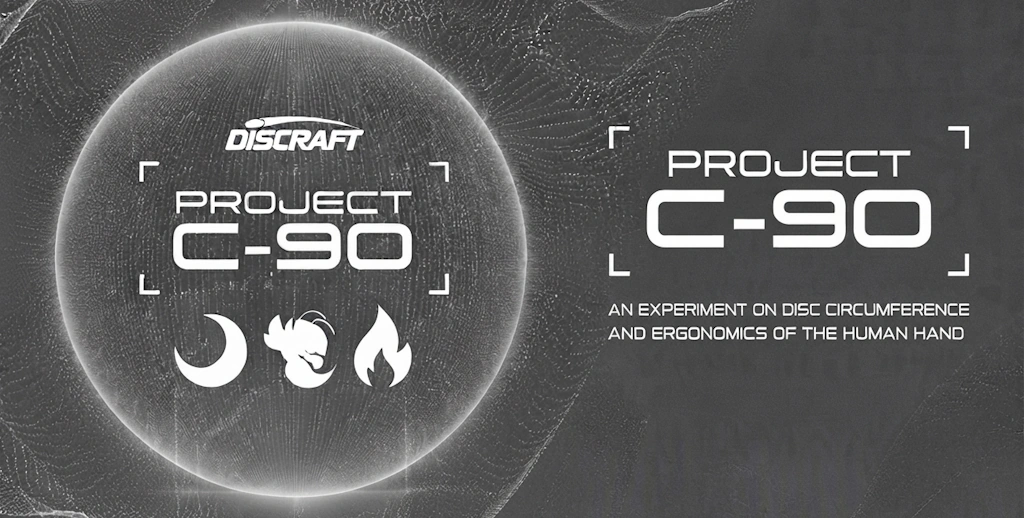
According to Discraft’s official Project C90 documentation, this is not being treated as a traditional product launch. Instead, the company is positioning it as a large-scale field test designed to answer a fundamental question:
“What if a smaller-format disc could still deliver a legitimate, consistent, and competitive flight?”
To explore that idea, Discraft selected three of its most recognizable molds: The Luna, the Buzzz, and the Heat.
Together, they represent three distinct parts of the disc golf experience. The Luna brings putting and approach performance, the Buzzz serves as one of the most trusted midranges in the sport, and the Heat provides a platform for testing driver performance in a reduced-size format.
Each has been scaled to 90 percent of the parent mold’s circumference, a detail Discraft repeatedly emphasizes. The distinction matters because many players initially assumed C90 referred to 90 percent of the original diameter. It does not.
Discraft is also making the community part of the process. Early runs were scheduled to debut during the 2026 PDGA World Championships, both in person and through the Discraft Factory Store, putting the future of the concept directly into players’ hands.

The math reveals a bigger difference than you think
The term C90 sounds straightforward, but the numbers tell a more interesting story.
Using a standard Discraft disc with an approximate diameter of 8.35 inches, the original circumference is roughly 26.22 inches. Reducing that circumference to 90 percent results in approximately 23.58 inches, which translates to an estimated diameter of about 7.52 inches.
While a reduction of just over two centimeters may not sound significant, the impact becomes much more substantial when surface area is considered.
A disc measuring 7.52 inches in diameter has only about 81 percent of the flight plate area of a standard 8.35-inches disc.
In practical terms, Project C90 creates a disc with nearly 19 percent less overall surface area, not merely a disc that is 10 percent smaller.
That difference could fundamentally change how the disc feels in the hand, how it releases from the fingers, and how it interacts with the air during flight.
Why Discraft chose Luna, Buzzz, and Heat
The choice of molds appears highly strategic.
The Luna was selected because of its instantly recognizable feel and reputation for control and versatility. Made famous by six-time World Champion Paul McBeth, the Luna provides an ideal foundation for understanding how players react to a smaller putting platform while retaining the identity of the original mold.
The Buzzz serves as what Discraft calls the perfect control group. Few discs in the sport are as universally known and trusted. Because so many disc golfers understand exactly how a Buzzz should feel and fly, it becomes easier to identify what changes when the dimensions shrink.
The Heat completes the lineup by introducing speed into the equation. As one of Discraft’s most approachable distance drivers, it offers a valuable opportunity to evaluate how driver characteristics translate into a more compact disc format.

Could smaller discs fly completely differently?
This is where Project C90 becomes genuinely fascinating.
Discraft is not presenting these discs as miniature versions of existing molds. Instead, the company describes them as offering a substantially different physical experience while preserving the recognizable DNA of the original designs.
The smaller diameter could make the discs noticeably more comfortable for players with smaller hands and may allow some players to generate cleaner, faster releases.
Reduced surface area may lower drag, potentially creating different speed characteristics. At the same time, less surface area also means less lift, which could impact glide and carrying distance.
Wind interaction may change as well. With less disc exposed to airflow, headwind and crosswind performance could differ substantially from traditional molds.
Perhaps most interesting is what happens to stability. Any change in rim dimensions, dome profile, overall weight, or mass distribution can alter gyroscopic behavior and affect how the disc holds its angle throughout flight.
For putters in particular, such as the Luna, these differences could be felt immediately on the putting green.
At this stage, however, much remains theoretical. That uncertainty is precisely why Discraft is treating Project C90 as a large-scale experiment rather than claiming it represents the future of disc golf.

The PDGA challenge could be the biggest story
Beyond flight characteristics, Project C90 faces another obstacle: current PDGA regulations.
Under today’s PDGA Technical Standards, approved Global Class discs generally must have an outside diameter of at least 8.27 inches. Based on the dimensions implied by the C90 design, these discs would likely fall below that threshold.
Discraft openly acknowledges this reality.
On the official Project C90 page, the project is listed as “Seeking PDGA Approval,” and the company states that the concept is being presented to the PDGA for review as part of its commitment to helping grow the sport.
That transforms Project C90 from a limited-run curiosity into something potentially much more significant.
Discraft is effectively testing whether there is genuine player demand for a smaller disc format. If the response is positive, it could eventually spark broader conversations about equipment standards, player accessibility, and the future evolution of disc golf.
Learn more: Most popular discs of 2026
Could Project C90 change disc golf forever?
The most compelling aspect of Project C90 is that Discraft is not pretending to know the outcome.
Instead, the company is placing the experiment directly into the hands of players and encouraging feedback from the community. The success or failure of the concept will not be determined solely in a laboratory or boardroom. It will be decided on courses, practice fields, and putting greens around the world.
Learn more: Discraft expands Project C90
For decades, disc golf has operated within a relatively narrow range of dimensions that most players simply accepted as standard. Project C90 asks a provocative question: are those dimensions essential to the game, or are they simply traditions that have never been challenged?
If the answer turns out to be the latter, Project C90 may ultimately be remembered as more than a limited release.
It could become the first serious step toward an entirely new category of disc golf equipment.
Whether C90 becomes the future of the sport or remains one of its most intriguing experiments, one thing is already certain:
Discraft has started a conversation that the entire disc golf world will be watching closely.
Sources
Discraft Project C90 Official Page
Discraft 2026 PDGA Worlds Release Announcement