Last updated: September 21, 2026
For many disc golfers, fall feels like the beginning of the end. The long summer evenings disappear surprisingly quickly.
In this article
Temperatures begin to fall, fairways stay wet for longer, leaves cover the ground, and an after-work round that was easy to fit in during July may suddenly end in darkness.
But fall does not have to mark the end of the disc golf season.
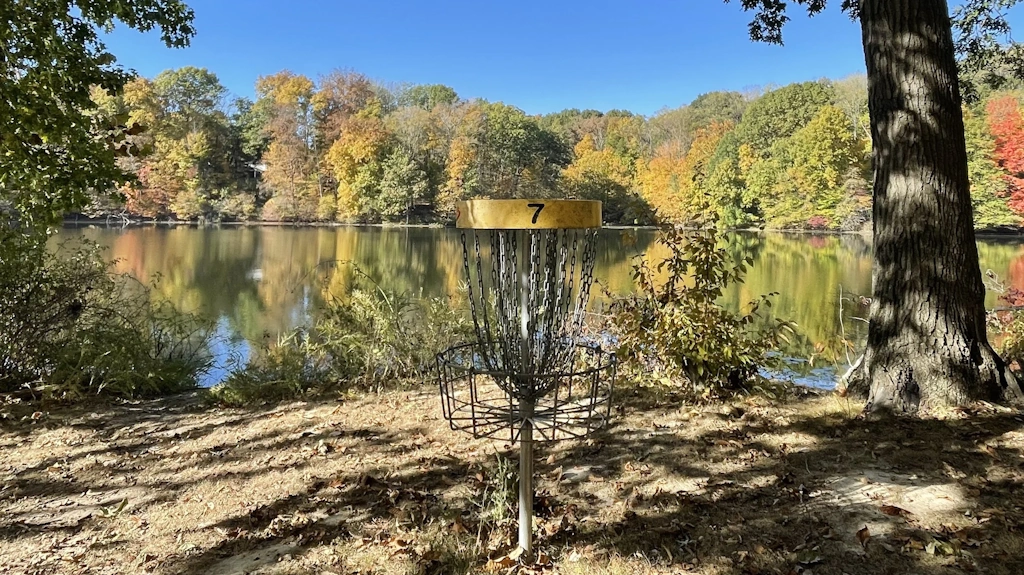
In many places, it is one of the most rewarding times of the year to play. The courses are often quieter, the air is cooler, and familiar fairways take on a completely different character as the leaves change color and begin to fall. The conditions require a few adjustments, but not an entirely new bag or a complete change in how you play.
The real question is not whether you can continue playing after summer. It is how you adapt without making autumn disc golf more complicated than it needs to be.

The course changes before your game does
The transition from summer to fall is gradual. You may first notice that the grass remains wet during morning rounds or that the temperature drops more quickly once the sun disappears. A few weeks later, the course can look and play noticeably different.
Trees that created dense walls of foliage in summer begin to open up. Lines that appeared narrow in July may suddenly look more inviting. A branch has not moved, but with fewer leaves around it, the available space can seem much larger.
That does not mean every newly visible line is a good one. Small branches remain even after the leaves are gone, and a route that looks open from the tee may still contain plenty of obstacles. Fall does, however, give you an opportunity to look at familiar holes differently.
Innova makes the same observation in its fall disc golf guide, noting that falling leaves can reveal routes through wooded fairways that were much less obvious during summer. The sensible approach is to explore those possibilities without abandoning the reliable lines you already know.
The ground also begins to change. Dry summer fairways become softer, leaves hide roots and small holes, and tee pads can remain damp long after the last rainfall. None of this necessarily prevents you from playing, but it should influence how aggressively you move through the course.
Fall rewards awareness more than force.
Fallen leaves can hide more than the rough
A disc does not need deep snow to disappear.
A thick layer of leaves can hide a disc almost completely, even in the middle of the fairway. The disc may cut beneath the top layer as it lands or slide several feet from the point where you last saw it.
Color becomes more important during fall. Orange, red and yellow discs that were highly visible against green summer grass can blend into autumn leaves. Light blue and bright pink often provide better contrast against the browns, reds and yellows commonly found on fall fairways. Innova specifically recommends considering disc color during autumn and identifies light blue and pink as useful options.
You do not need to rebuild your bag around seasonal colors, but it may be worth leaving your hardest-to-see discs at home on courses with heavy leaf cover.
The most effective method is even simpler: watch every throw until it stops.
Pay attention to a nearby tree, branch, rock or other fixed reference point. If the disc disappears into the leaves, walk toward that reference instead of searching the general area where you think it landed. When playing in a group, ask someone to move farther up the fairway as a spotter on holes where the landing zone is difficult to see. Innova also recommends using a spotter when thick leaf cover makes discs difficult to locate.
Avoid immediately walking through the entire landing area. A disc that has slipped beneath the leaves may have left a visible line or disturbed section on the surface. That clue is much easier to see before several people have walked over it.

Wet conditions change the routine
Fall does not always mean playing in the rain. More often, it means playing on a course that has not fully dried.
Dew, damp grass, light showers and moisture from fallen leaves can leave your discs wet even when it is not actively raining. A dry-looking tee pad may also contain a thin layer of moisture that becomes noticeable only when you plant your foot.
This is where a few basic routines make a significant difference.
Bring more than one towel. Keep at least one of them protected inside your bag or in a waterproof compartment. The towel attached to the outside of your bag will eventually become damp, especially if it repeatedly touches wet grass or leaves.
Use one towel to remove most of the moisture and save the driest towel for the final wipe before throwing. Dry your throwing hand as well as the disc. Wiping the flight plate while leaving the rim or your fingers wet only solves part of the problem.
Disc Golf United similarly recommends carrying several towels in wet conditions and protecting the unused ones in a bag until they are needed. The guidance also emphasizes keeping the throwing hand dry rather than focusing only on the disc.
Try to develop the same routine before each throw: inspect the lie, check your footing, dry the disc, dry your hand and then choose your stance. Making that sequence habitual is easier than rediscovering the problem after a disc slips during the release.
Grip matters, but footing matters more.
If the tee pad, grass or leaves feel slippery, shorten your run-up or throw from a standstill. A few feet of additional distance are not worth an uncontrolled plant or a fall. You may also find that a slower and more deliberate approach improves your timing when the ground prevents you from relying on speed.

Dress for the round, not the parking lot
Fall weather can be difficult to judge from the parking lot.
The first few minutes may feel cold, especially if there is wind or little sunlight. Once you begin walking, carrying a bag and throwing, the same clothing can quickly feel too warm.
Layers are usually more practical than one heavy jacket.
A light base layer can be combined with a warmer middle layer and a wind-resistant or waterproof outer shell. This allows you to remove or add clothing during the round without limiting movement through your shoulders and upper body.
The objective is not to stay as warm as possible. It is to remain comfortable without restricting your throw.
Before leaving home, make a few slow throwing movements while wearing the clothes you plan to use. If the jacket pulls across your shoulders or prevents a natural reach-back, it will probably become more distracting on the course.
Footwear becomes equally important. Fall fairways can combine wet grass, mud, exposed roots and slippery leaves within the same hole. Shoes that provide reliable traction and keep your feet reasonably dry can improve the entire round more than most additions to your disc golf bag.
Extra socks are also worth leaving in the car. Wet feet may not ruin the opening holes, but they can make the second half of the round unnecessarily uncomfortable.
Learn more: Which shoes should you use for disc golf?
Cold hands can arrive before cold weather
You do not need freezing temperatures to lose some feeling in your fingers.
Cool air, wind and moisture can make the throwing hand uncomfortable surprisingly early in the fall. The challenge is finding enough warmth without losing the direct connection with the disc.
For many players, the simplest solution is to wear a glove or mitten between throws and remove it when throwing. This keeps the hand protected while walking without changing the familiar grip on the disc.
Thin gloves may work in mild conditions, while warmer mittens can be more effective later in the season. Hand warmers can also help if your fingers become cold quickly, but they are not essential for every fall round.
The goal is to keep the hand comfortable and functional, not hot.
It also helps to avoid using your throwing hand for every other task. Carrying wet equipment, moving branches, picking up a damp bag and handling a phone all expose the hand to additional moisture. When practical, use your non-throwing hand for those jobs and keep the throwing hand dry.
Your discs may feel different as temperatures fall
The first genuinely cool rounds of fall can make familiar discs feel slightly different.
The most immediate difference is often grip rather than flight. A plastic blend that felt comfortable during a warm summer afternoon may feel firmer when the temperature drops. Dry or cold hands can make that change even more noticeable.
There is no reason to replace your entire bag as soon as summer ends.
Start with the discs you already know. If a specific driver becomes uncomfortable to hold or difficult to release cleanly, try the same type of shot with a softer plastic blend or a disc that requires less power. Innova</Innova notes that more flexible plastic can provide a useful combination of grip and pliability as fall temperatures decrease.
The important distinction is between adapting and overreacting.
One poor round in cooler weather does not mean every disc has become unsuitable. More clothing, a wet tee pad, cold fingers and stronger wind may all affect the result. Change one thing at a time so you can identify the actual problem.
Wind becomes harder to ignore
Fall often makes the wind more noticeable.
As foliage thins, wooded courses may feel more exposed. Open fairways can also play differently when the weather changes quickly during the round. A calm opening hole does not guarantee calm conditions by the time you reach the back nine.
You do not need a complete set of specialized wind discs, but you should pay attention to how the wind affects the shot before choosing your disc and release angle.
A headwind can exaggerate turn and make a disc behave less stable than expected. A tailwind can reduce turn and encourage an earlier fade. Crosswinds can lift or push the exposed side of the disc, particularly when the nose or wing is presented to the wind.
When the wind is unpredictable, control usually matters more than maximum distance. A slower disc thrown with commitment is often easier to manage than a high-speed driver that requires a perfect release.
Fall is a good time to simplify your decisions. Choose the line with the largest margin for error, keep the disc closer to the ground when appropriate, and avoid turning an ordinary hole into a technical experiment simply because the wind has changed.
Shorter days require better planning
The most noticeable transition from summer to fall may have nothing to do with temperature.
You simply run out of daylight.
An after-work round that once began in full sunshine can finish in deep shade only a few weeks later. Wooded holes become dark before open areas, and searching for a disc in fallen leaves takes more time than looking for one on summer grass.
Check when the sun sets before starting the round, but do not treat sunset as the exact moment visibility disappears. Cloud cover, terrain and dense woods can make a course difficult to navigate well before then.
Starting earlier is the obvious solution, but it is not always possible. You can also choose a shorter layout, play fewer holes or use a course you know well enough to navigate safely as the light begins to fade.
Bring a small flashlight or headlamp even if you expect to finish before dark. It can help you find a disc among the leaves, pack your bag after the final hole or walk safely back to the parking area.
If shorter days repeatedly interrupt your rounds, fall is also the ideal time to try glow disc golf.

Glow disc golf changes the season
Glow disc golf is not only a solution to diminishing daylight. It can become one of the best parts of fall.
A familiar course feels completely different after dark. Distances become harder to judge, wooded fairways appear narrower, and the glowing flight of a disc creates an experience that ordinary daytime rounds cannot reproduce.
You do not need to replace every disc in your bag.
Start with a putter, a midrange and perhaps one driver in familiar molds. A UV flashlight charges glow plastic quickly and is less disruptive to your night vision than repeatedly using a powerful white flashlight. Innova recommends UV light for charging glow plastic and suggests choosing a familiar, manageable layout for nighttime rounds.
The basket also needs to be visible. A portable basket light can work well, provided the course permits it and everything is removed afterward.
Bring a normal flashlight or headlamp for walking, locating obstacles and dealing with practical tasks. UV light may be effective for charging glow discer, but it is not a replacement for proper lighting when moving around the course.
Play somewhere familiar, make sure the fairway is clear and be mindful of paths, homes and other people using the area. Darkness changes what you can see, but it also makes it harder for others to see you.
You do not need a separate fall bag
Seasonal advice can easily turn into a shopping list. New shoes. Softer plastic. Glow discer. Three towels. Different gloves. A waterproof bag. Another jacket. Most players do not need to buy everything before their first fall round.
Start with suitable clothing, dependable footwear, a few towels and the discs you already trust. Pay attention to what actually becomes a problem.
If your discs disappear among leaves, change the colors you bring. If your grip suffers, keep more towels dry or test a softer plastic. If cold fingers distract you, bring a glove or hand warmer. If darkness repeatedly ends the round, try a small glow setup.
Equipment should solve a problem you have experienced, not one an article tells you to expect.
Fall can make familiar courses interesting again
Summer often encourages speed. There is plenty of daylight, the footing is predictable and the course looks familiar. Fall changes the rhythm.
You may need to watch throws more carefully, reconsider your footwear, shorten the run-up or select a different line through a wooded fairway. You become more aware of the ground, the wind and the remaining daylight.
Those adjustments do not necessarily make the round worse. They make it different.
A quieter course gives you time to experiment. Cooler conditions can make long rounds more comfortable. Changing leaves create some of the most attractive scenery of the year, while thinning foliage reveals details in the course that were hidden throughout summer.
The goal is not to pretend that wet leaves, fading light and colder fingers are always enjoyable. It is to prevent manageable changes from ending the season prematurely.
Know when to turn around
Continuing to play through fall does not mean ignoring the conditions.
Strong winds, thunderstorms, falling branches, flooded areas and dangerously slippery tee pads are good reasons to shorten or cancel a round. Darkness can also become a safety issue on an unfamiliar course, particularly where fairways cross paths or public areas.
There is a difference between adapting to uncomfortable conditions and accepting unnecessary risk.
If you cannot see the landing area, do not throw. If the tee pad does not provide safe footing, use a controlled standstill where permitted or skip the hole. If wind or rain makes wooded areas unsafe, come back another day.
There will always be another round.
The season does not end with summer
The transition into fall can feel abrupt. One week you are finishing a round in comfortable evening sunlight. A few weeks later, the fairway is covered in leaves and you are checking how much daylight remains before deciding whether to play another hole.
That does not mean the disc golf season is over.
Fall offers quieter courses, cooler air, changing landscapes and opportunities to discover new lines on familiar holes. It also introduces wet discs, slippery leaves, stronger wind and less daylight. Most of those challenges can be handled with small, practical adjustments.
Bring extra towels. Choose disc colors that stand out against the leaves. Dress in layers. Watch every throw until it stops. Adjust your run-up when the ground is wet, and carry a light when the round may continue toward sunset.
If darkness becomes a regular part of your after-work rounds, try glow disc golf instead of waiting for summer to return.
You do not need to turn fall into an endurance test or start preparing for extreme winter conditions. You only need to recognize that the course has changed and adapt with it.
Do that, and some of the best rounds of the year may still be ahead of you.
Sources
Innova Disc Golf: Innova’s Top 6 Tips for Fall Disc Golf
Innova Disc Golf: Glow Disc Golf – Light Up the Course
Disc Golf United: Mastering Bad Weather Disc Golf