
Last modified: July 17, 2026
Putting is the aspect of disc golf that truly decides how good your round will be. Although long drives often get the most attention, the majority of throws actually occur at short distances, and this is where you can save the most strokes.
In this article
Many discers find that minor adjustments in putting quickly lead to lower scores, as this is the most repetitive part of the game.

What does putting entail?
Putting in disc golf is all about throwing a putter disc toward the basket with precision and control, usually from short distances within what is defined as “Circle 1″— meaning costly 10 meters (33 feet) or less from the basket. In contrast to longer throws, raw power is not the deciding factor; instead, a stable and repeatable motion that allows you to hit the chains consistently and accurately is what matters.
Fundamental technique for better putts
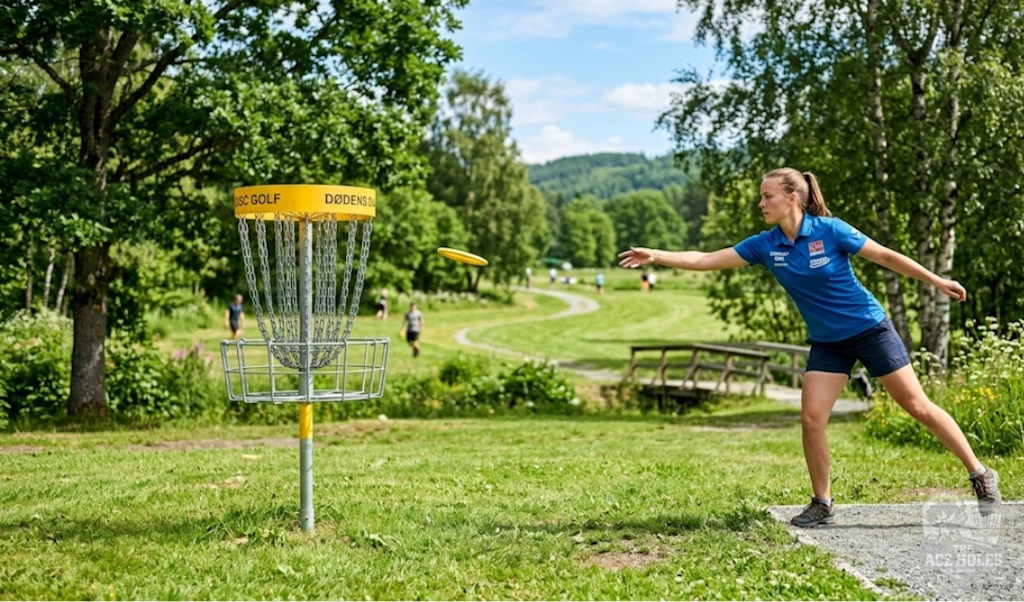
To execute a good putt, you must have control over a few fundamental technical elements. The grip is the first thing many notice, and most discers use a variation where the fingers are fanned out underneath the disc to provide excellent control and a clean release, with the index finger placed on the front edge. At the same time, your stance is critical. A classic approach is the staggered stance, with one foot in front of the other, which offers excellent balance and makes it easier to actively utilize your body weight during the throw. Alternatively, you can stand with your feet parallel in a so-called straddle stance, which provides extra stability, particularly when you need to putt around obstacles.
When initiating the putting motion itself, the power should generate from your body and legs, not just your arm. Many discers start with their weight on the back foot and smoothly shift it forward toward the basket as the disc is released. A good putt features a smooth, controlled motion, and the follow-through is vital. Your arm should extend fully in the direction of the basket even after the disc has left your hand, which contributes to better accuracy and more consistent results.

The primary putting styles
When it comes to the putting style itself, there are several different approaches, but most can be divided into three main types.
The first is the spin putt, which is one of the most widely used styles. Here, the wrist is actively engaged to generate substantial rotation on the disc, making the putt travel relatively straight and direct toward the target. This type of putt performs exceptionally well in windy conditions because the heavy spin makes the disc more stable in the air. On the flip side, it can be slightly more demanding to control, and misses will often spit out or sail a significant distance past the basket.
The second main style is the push putt, which relies much more on “pushing” or lofting the disc toward the basket. This technique involves minimal wrist movement and significantly less spin, causing the disc to follow a more lofted, arched trajectory through the air. This technique often yields superior control at short distances and ensures that misses drop and settle close to the basket, reducing the risk of stressful comeback putts. The disadvantage is that it is highly sensitive to the wind and can be more difficult to execute on longer putts.
Related reading: Getting started with disc golf
In practice, however, many discers do not utilize a pure spin or push putt, but rather a combination of the two. This hybrid style is frequently referred to as a “spush” putt, offering a clean balance between control and power. For many players, this style feels the most natural, and it is common for discers to develop their own personal variation as they gain experience.
Special putts and situations
In addition to these foundational styles, there are also specialized putts used in specific scenarios. The turbo putt is one example, where the disc is thrown overhand (supported by the fingers on the inside rim) to clear bushes or other low obstacles. The jump putt is commonly utilized outside the 10-meter mark to generate extra distance and momentum, serving as a highly effective tool when you just need that extra bit of power to reach the chains.
Putting drills for rapid progress
To build a confident and reliable putt, regular practice is absolutely essential. Employing structured drills makes the learning process both easier and far more motivating. An effective approach is to start close to the basket and gradually work your way backward. Standing close gives you an immediate sense of accomplishment and teaches your muscle memory how to release the disc correctly. Over time, you can systematically increase the distance to challenge yourself further.
Related reading: 6 Quick Putting Tips
Another highly useful method is putting from various angles around the basket. On the course, you rarely end up perfectly dead-center in front of the chains, and practicing from multiple positions makes you far more comfortable in tricky situations. Many discers also see great results by setting specific goals—such as making a certain number of putts in a row—which brings both structure and intense focus to your practice routine.
The most important factor with these drills is not a complex setup, but rather repeating the exact same motion numerous times. Putting is a skill that improves rapidly with consistent training because the mechanics are short and highly controlled. Small refinements in technique and confidence will therefore translate directly into visible results out on the course.

What characterizes a good discer on the green?
What sets elite putters apart, regardless of their preferred style, is the ability to replicate the exact same motion time and time again. They almost always follow a fixed pre-putt routine before every throw, focus their eyes on a specific link in the chains, and maintain perfect body balance throughout the entire sequence. Putting is therefore just as much about rhythm, cadence, and mental confidence as it is about raw mechanics.
Common mistakes that hinder good putts
Many discers find themselves missing because they alter their technique too frequently or try to adjust too many variables at once. It is generally far more effective to commit to a single style and refine it over a long period. Minor flaws in release angle or body position carry much heavier consequences at short distances, which is precisely why consistency is paramount.
How to become a better putter
If you want to improve your putting game, there are no shortcuts around deliberate practice. What makes putting unique is that you can practice almost anywhere, and progress comes relatively quickly if you train systematically. Many use simple drills where they putt from the same distance multiple times or move dynamically around the basket to gain experience from different angles. With a little structure, you will quickly notice more putts clicking, and your confidence will soar.
Summary
Ultimately, putting comes down to finding a style that fits you and making it as bulletproof as possible. Some will thrive with a direct, powerful spin putt, others will prefer the calmer control of a push putt, while many will find their own ideal balance somewhere in the middle. The most important thing is not which style you choose, but how consistently you can execute it. Once you master your putting, you will quickly notice your entire game reach a whole new level.


